Aloha Everyone! 💥
Today is my last day here at HIMB for my internship this summer, as I will make my way back to Massachusetts and Smith College. I have had a fantastic time here over the past few months, and I am so grateful to have had the opportunity to be a part of our CEP team. Over my time here, I have met many wonderful people who have always been so caring, friendly and inviting to someone far from home like me! I have had the opportunity to run and help with many tours, labs, and an overnight, as well as work on a few different projects, such as creating new signage for our touch tanks and new cue cards for our walking tours. Just the other day I created a worksheet for our labs and classes that will be put into use soon. I have been out almost every day cleaning the touch tanks, one of my favorite activities here since I get to spend time with some of our lovely creatures. Overall, this has been a wonderful experience that I will look back on and cherish. But I won't be gone too long, as I plan on coming to visit this winter, and perhaps running some more tours then!
See you soon,
Ginny Svec 😄
CEP Intern

Showing posts with label Marine Life. Show all posts
Showing posts with label Marine Life. Show all posts
Thursday, August 30, 2018


Friday, September 12, 2014
Coral-eating Sea Slug, Phestilla lugubris, Bane of a Coral Keeper's Tank
 |
| View of the Porites compressa on Monday morning. Photo - M. Heckman |
Trying to recreate nature in an aquarium is always a tough thing to do. We strive to keep a relatively harmonious mix of creatures in our touch/observation table. But with raw seawater coming in and clumps of new sponge continuously being added for the tiger cowries to eat, it is inevitable that some less desirable characters will appear.
Such was the case again recently - we have been having an infestation, which seems to happen to us at least once a year. When I leave on Friday for the weekend, I always check the tank and typically the corals look good. But about once or twice a year when I come in Monday morning, pieces of the finger coral (Porites compressa) have gone from healthy to compromised. They have big white blanched areas down near their base.
 |
| Phystilla sea slug, C. Pittman photo |
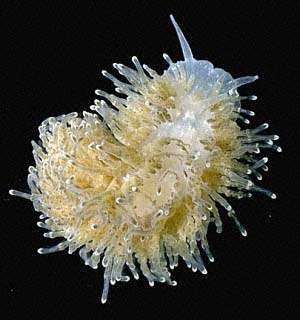
The culprit is easy to guess, the white sickly looking area is living tissue devoured by the coral eating sea slug Phestilla lugubris. This is an animal feared by those that try and raise Porites (finger and lobe) corals in captivity. Outbreaks can be devastating if not checked. A quick examination of any coral in question typically reveals a large (well fed) specimen of Phestilla settled between two of the coral's branches.
 |
| Note sea slug at top, areas that the sea slug has eaten and the various egg masses that it has laid - all in one weekend. |
 |
| Closer view - M. Heckman Photo |
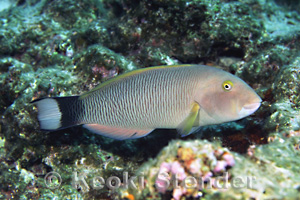 |
| Old woman wrasse |
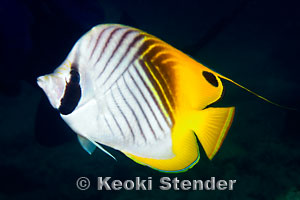 |
| Threadfin butterflyfish |
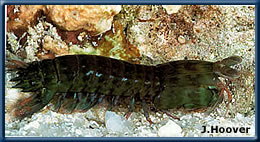 |
| Gonodactylaceus mantis shrimp from Introduced Marine Species of Hawaii |
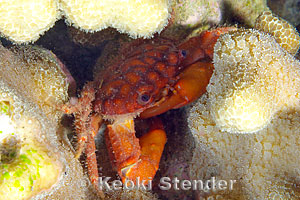 |
| Areolated xanthid crab |
These are very interesting animals. They are one of the few sea slugs that scientist have figured out their entire life history - think egg to adult in less than 40 days, adults live only a few months, laying thousands of egg a day, then die a couple of weeks later. Contrast this to an adult sea cucumber that might live decades. Some invertebrates move slow and live slow, some move slow and live fast. Phestilla may take down 10 square inches of coral a day, lay thousands of eggs and pass away, leaving their progeny to continue on.
Crawl slow, eat large, live fast.
For some great sites on these animals (and some of my references for this article), see:
 |
| Bill Rudman photo |
 |
| Pauline Fiene photo |
 |
| Dana Riddle Photo |
A recent article (this month) in Advanced Aquarist by Dana Riddle on coral eating sea slugs. Broad coverage, information for those who keep corals in captivity and the most up to date information. See: //www.advancedaquarist.com/2012/6/inverts
Other references
Control of populations of the coral-feeding nudibranch Phestilla sibogae by fish and crustacean predators. D.J. Gochfeld and G.S. Aeby. MARINE BIOLOGY, Vol. 130, Number 1 (1997)

Friday, October 4, 2013
Cleaner Wrasse: 'Doctors' of the sea
This week there was an article by Susan Scott in the Star Advertiser discussing the role of cleaner wrasses in the exfoliation of dead cells and parasites. In the article she mentioned that she had been on a long sailing trip, which meant she had 'taken a break from her grooming chores.' When she went to snorkel on a reef, she noticed as she came across some Cleaner Wrasses they took a liking for her and started to clean and exfoliate her skin.
 |
| http://www.marinelifephotography.com/fishes/wrasses/wrasses.htm |
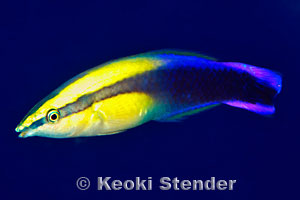
For those who may not know much about this species, the Cleaner Wrasse plays an important role in the well being of larger fish. Hawaii has only one endemic cleaner wrasse characterized by a brilliant yellow and purple contrast. Like most wrasses, they do change sex from females to males, usually between the ages of 1 and 3 years. Some may refer to them as the 'doctors' of the sea. This is because they help remove unwanted parasites from the hosts, and therefore it could be considered that mutual relationship develops. However, there are times when the cleaner wrasse quite literally might bite off more than they can chew.
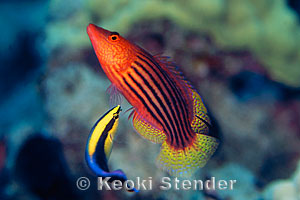 |
| Cleaner Wrasse working on a Eight-lined Wrasse http://www.marinelifephotography.com/fishes/wrasses/labroides-phthirophagus.htm |
There have been studies undertaken to determine potential conflicts which may occur between cleaners and clients (other fish) if the cleaners take out a portion of mucus or tissue from the client they are 'cleaning.' Studies by Grutter and Bshary have found that the cleaners have a greater affinity for mucus and tissue of the client than some parasites. This could suggest that the relationship is not mutualistic. However, the study further elaborates on the findings, mentioning behavioral characteristics could play a factor in partner control. It was mentioned in the introduction that clients do control cleaner interactions through partner switching (changing to another cleaner wrasse) and even punishment. Susan Scott mentioned in her article that she felt a tickle on her leg followed by a painful little tug. I wonder whether she is now finding another cleaning station.
Aloha,
Ben
Further Reading:
Susan Scott’s article (Need to sign into honolulu star for full article) http://www.staradvertiser.com/s?action=login&f=y&id=225777431&id=225777431
Grutter and Bshary’s article http://rspb.royalsocietypublishing.org/content/270/Suppl_2/S242.short
Friday, June 21, 2013
Zoanthids
You may recognize these critters from the No-Touch Table. These anemone-looking animals are called zoanthids, stemming from the order zoanthinaria. Belonging to the phylum cnideria, zoanthids are loosely related to corals and jellies. In fact, zoanthids are soft corals.

When most people think about coral, one of the first things that comes to mind is a colorful, tropical coral reef. The grand majority of a reef is composed of coral skeleton. Unlike the stony or hard corals, zoanthids are soft corals which lack an internal limestone skeleton. Instead of having a rigid internal skeletal structure, their bodies are tough and leathery.

Being cnidarians, zoanthids fall under the same phylum as corals and jellies. One characteristic that all cnidarians share is the ability to catch prey using stinging cells called nematocysts. The sting of some nematocysts can be excruciatingly painful. The sting of a zoanthid, however, is benign to humans. To compensate for their stinging short-comings, certain species of zoanthid can secrete toxins as a deterant.
One species of zoanthid, Palythoa toxica, produces polytoxin, one of the deadliest toxins known to man. Ancient Hawaiian warriors of Maui would tip their spears with polytoxin to ensure the wounds they inflicted would be deadly.

Not all zoanthid species are toxic. It was thought that the species being sold for home aquariums where all of the non toxic variety. In a publication from 2011, researchers tested zoanthids being sold from home aquarium stores within the United States. Zoanthids containing the deadly polytoxin were found in three aquarium stores in the Washington DC area.
These incidents of toxic animals in a retail setting may be due to mistaken identity. Zoanthid species can be extremely difficult to distinguish from one another. Even deciphering between the genera of Palythoa and Protopalythoa can be nearly impossible without DNA analysis. This is why our green zoanthids are residing in the No-Touch Table.

They are green. They are zoanthids. We think they are Protopalythoa, but we aren't taking any chances.
For more information about the toxic zoanthids found in home aquarium stores, follow the link below.
Aloha,
Leon
Palytoxin found in Palythoa sp. zoanthids (Anthozoa, Hexacorallia) sold in the home aquarium trade.
http://www.ncbi.nlm.nih.gov/pubmed/21483745

When most people think about coral, one of the first things that comes to mind is a colorful, tropical coral reef. The grand majority of a reef is composed of coral skeleton. Unlike the stony or hard corals, zoanthids are soft corals which lack an internal limestone skeleton. Instead of having a rigid internal skeletal structure, their bodies are tough and leathery.

Being cnidarians, zoanthids fall under the same phylum as corals and jellies. One characteristic that all cnidarians share is the ability to catch prey using stinging cells called nematocysts. The sting of some nematocysts can be excruciatingly painful. The sting of a zoanthid, however, is benign to humans. To compensate for their stinging short-comings, certain species of zoanthid can secrete toxins as a deterant.
One species of zoanthid, Palythoa toxica, produces polytoxin, one of the deadliest toxins known to man. Ancient Hawaiian warriors of Maui would tip their spears with polytoxin to ensure the wounds they inflicted would be deadly.

These incidents of toxic animals in a retail setting may be due to mistaken identity. Zoanthid species can be extremely difficult to distinguish from one another. Even deciphering between the genera of Palythoa and Protopalythoa can be nearly impossible without DNA analysis. This is why our green zoanthids are residing in the No-Touch Table.

For more information about the toxic zoanthids found in home aquarium stores, follow the link below.
Aloha,
Leon
http://www.ncbi.nlm.nih.gov/pubmed/21483745
Saturday, May 4, 2013
Sea Spiders!
As if there wasn't enough to worry about while swimming in the ocean, a new threat emerges; SEA SPIDERS!!! They swim, they crawl, they can grow a leg span of over two and a half feet! They have a proboscis with which to suck your precious life fluids...
Well - actually they are mostly less than 1/2 inch across, tremendously slow, and only a threat if you are a tiny soft bodied invertebrate.
Pycnogonida (PIK-nuh-GON-uh-duh) is the Class of Arthropoda to which all sea spiders belong. They also belong to the sub-phylum Chelicerata, which means that they share common ancestry with true spiders, scorpions, and horseshoe crabs. In addition to their chelicera (pointed mouth parts particular to this group), most species possess four pairs of legs.
The thorax comprises the bulk of the body, though it pales in comparison to the legs. The body is so small that it looks as though its only purpose is to connect the legs. The minimalism of the body and the slender appearance of the legs has given way to these discoveries:

The chest of a pycnogonid is so small there isn't room for lungs, so they breath by diffusion.
The legs of a pycnogonid are so thin, each leg only has one muscle cell surrounded by connective tissue.
The digestive tract of a pycnogonid runs into its legs because there isn't room in there body.
Pycnogonids are soo thin, they make stick-bugs look fat (not a fact).
Seriously, these emaciated looking arthropods are well adapted to surviving in a wide range of environments extending from the poles to the tropics. Most species are found in shallow water, but some species can be found at depths as low as 7000 meters. They have also been around longer than sharks. One species of pycnogonida , Haliestes dasos, is estimated to have lived 425 million years ago.
The best part about pycnogonida is that their diet does not include terrestrial mammals, like you, me, and Lassie. Most pycnogonids are parasitic predators whose feeding is more reminiscent of a mosquito than that of a true spider. The majority use their proboscis to feed upon soft-bodied invertebrates like sponges, anemones, hydroids, polychaete worms, and bryozoans.
Generally, pycnogonids develop a preference for a single prey item based on what they ate as juveniles. However, studies show that one species in the Mediterainian will change its diet according to the season. The pycnogonid Ammothella longipes will prey upon polychaete worms when their numbers abound in the spring and summer. When polychaete populations decline in the winter, A. longipes feeds upon detritus, dead organic mater.
So if you're swimming in the ocean and you see eight slender segmented legs flailing about, remember that they're not real spiders, and they are not after your life fluids, but possibly your detritus.
Aloha,
Leon
If you are interested in learning more about pycnogonids, please check out the following links:
Pycnogonida (Sea Spiders) http://www.earthlife.net/chelicerata/pycnogonida.html
Fossil sea spiders thrill experts http://news.bbc.co.uk/2/hi/science/nature/6948161.stm
Early sea spider flashes pincers http://news.bbc.co.uk/2/hi/science/nature/3756614.stm
Bamber, R.N., El Nagar, A. (Eds) (2013). Pycnobase: World Pycnogonida Database. Available online at http://www.marinespecies.org/pycnobase/ accessed on 2013-05-03
Soler-Membrives, Anna; Rossi, Sergio; Munilla, Tomás. "Feeding ecology of Ammothella longipes (Arthropoda: Pycnogonida) in the Mediterranean Sea: A fatty acid biomarker approach" Estuarine, Coastal and Shelf Science. Volume 92, Issue 4, 20 May 2011, Pages 588–597. Accessed 2013-05-03 http://dx.doi.org/10.1016/j.bbr.2011.03.031
Well - actually they are mostly less than 1/2 inch across, tremendously slow, and only a threat if you are a tiny soft bodied invertebrate.
Pycnogonida (PIK-nuh-GON-uh-duh) is the Class of Arthropoda to which all sea spiders belong. They also belong to the sub-phylum Chelicerata, which means that they share common ancestry with true spiders, scorpions, and horseshoe crabs. In addition to their chelicera (pointed mouth parts particular to this group), most species possess four pairs of legs.
The thorax comprises the bulk of the body, though it pales in comparison to the legs. The body is so small that it looks as though its only purpose is to connect the legs. The minimalism of the body and the slender appearance of the legs has given way to these discoveries:

The legs of a pycnogonid are so thin, each leg only has one muscle cell surrounded by connective tissue.
The digestive tract of a pycnogonid runs into its legs because there isn't room in there body.
Pycnogonids are soo thin, they make stick-bugs look fat (not a fact).
Seriously, these emaciated looking arthropods are well adapted to surviving in a wide range of environments extending from the poles to the tropics. Most species are found in shallow water, but some species can be found at depths as low as 7000 meters. They have also been around longer than sharks. One species of pycnogonida , Haliestes dasos, is estimated to have lived 425 million years ago.
 |
| Pycnogonid image by L. Weaver |
Generally, pycnogonids develop a preference for a single prey item based on what they ate as juveniles. However, studies show that one species in the Mediterainian will change its diet according to the season. The pycnogonid Ammothella longipes will prey upon polychaete worms when their numbers abound in the spring and summer. When polychaete populations decline in the winter, A. longipes feeds upon detritus, dead organic mater.
 |
| Pycnogonid image by L. Weaver |
Aloha,
Leon
If you are interested in learning more about pycnogonids, please check out the following links:
Pycnogonida (Sea Spiders) http://www.earthlife.net/chelicerata/pycnogonida.html
Fossil sea spiders thrill experts http://news.bbc.co.uk/2/hi/science/nature/6948161.stm
Early sea spider flashes pincers http://news.bbc.co.uk/2/hi/science/nature/3756614.stm
Bamber, R.N., El Nagar, A. (Eds) (2013). Pycnobase: World Pycnogonida Database. Available online at http://www.marinespecies.org/pycnobase/ accessed on 2013-05-03
Soler-Membrives, Anna; Rossi, Sergio; Munilla, Tomás. "Feeding ecology of Ammothella longipes (Arthropoda: Pycnogonida) in the Mediterranean Sea: A fatty acid biomarker approach" Estuarine, Coastal and Shelf Science. Volume 92, Issue 4, 20 May 2011, Pages 588–597. Accessed 2013-05-03 http://dx.doi.org/10.1016/j.bbr.2011.03.031
Friday, April 5, 2013
Cool Nudibranch, Dendrodoris fumata, from Coconut Island this week
Aloha,
We had a H.S. group from Parker School out for an overnight last night. This morning they did an invasive seaweed lab and found a very cool sea slug/ nudibranch (naked gilled sea slug).
I asked the students to look it up and at first glance they keyed it out to Dendrodoris rubra from John Hoover's invertebrate book. But, there was some question about the ID. It seemed to be missing the light edge band. Good call on their part. I just had a look at it more closely and I am going with Dendrodoris fumata, the "smoky nudibranch" (name via Keoki and Yuko Stender's site).
The issues with identifying marine life show up well here - this species has a range of colors and is very close to a couple of other types in description. Our specimen, however, fits the D. fumata physical characteristics the best as far as I can tell. Add to this the fact that it came from a habitat similar to one described for others of this species that have been found in Hawaii - shallow protected waters (S. Johnson, 1982) and our id seems at least probable. In our case, this animal came from clumps of Gracilaria salicornia (gorilla ogo seaweed) in 1 - 3 feet of water along the edges of our salt water pool below the beach pavilion, Moku o Lo'e (Coconut Island) Kane'ohe Bay.
We will keep it in the observation pool over the
weekend and see if anyone more knowledgeable wants to come by and
comment or take more images.
Like many nudibranchs of this type, it most likely eats sponge. If that is the case, it was in the right location. The most common animals found in the invasive seaweed mats are various clumps of sponges!
For infomation on the other nudibranch we more commonly see in our seaweed labs, see our previous post: The Painted Sea Slug.
For more information on this nudibranch, see:
Smoky Nudibranch, from Keoki and Yuko Stenders MarineLifePhotograpy site http://www.marinelifephotography.com/marine/mollusks/slugs/dendrodoris-fumata.htm
The Sea Slugs of Hawaii site by Cory Pittman and Pauline Fiene
http://seaslugsofhawaii.com/species/Dendrodoris-fumata-a.html
The Sea Slug Forum site
http://www.seaslugforum.net/find/dendfuma
We had a H.S. group from Parker School out for an overnight last night. This morning they did an invasive seaweed lab and found a very cool sea slug/ nudibranch (naked gilled sea slug).
 |
| Image M. Heckman |
I asked the students to look it up and at first glance they keyed it out to Dendrodoris rubra from John Hoover's invertebrate book. But, there was some question about the ID. It seemed to be missing the light edge band. Good call on their part. I just had a look at it more closely and I am going with Dendrodoris fumata, the "smoky nudibranch" (name via Keoki and Yuko Stender's site).
The issues with identifying marine life show up well here - this species has a range of colors and is very close to a couple of other types in description. Our specimen, however, fits the D. fumata physical characteristics the best as far as I can tell. Add to this the fact that it came from a habitat similar to one described for others of this species that have been found in Hawaii - shallow protected waters (S. Johnson, 1982) and our id seems at least probable. In our case, this animal came from clumps of Gracilaria salicornia (gorilla ogo seaweed) in 1 - 3 feet of water along the edges of our salt water pool below the beach pavilion, Moku o Lo'e (Coconut Island) Kane'ohe Bay.
 |
| Dendrodoris fumata - image M. Heckman |
Like many nudibranchs of this type, it most likely eats sponge. If that is the case, it was in the right location. The most common animals found in the invasive seaweed mats are various clumps of sponges!
 |
| Upside down crawling across the water surface - image M. Heckman |
For more information on this nudibranch, see:
Smoky Nudibranch, from Keoki and Yuko Stenders MarineLifePhotograpy site http://www.marinelifephotography.com/marine/mollusks/slugs/dendrodoris-fumata.htm
The Sea Slugs of Hawaii site by Cory Pittman and Pauline Fiene
http://seaslugsofhawaii.com/species/Dendrodoris-fumata-a.html
The Sea Slug Forum site
http://www.seaslugforum.net/find/dendfuma
Friday, January 18, 2013
LUCIFER - the planktonic shrimp

When looking through the microscope at plankton samples, students are often startled when we tell them that they are looking at "Lucifer." To be more specific, it is a planktonic shrimp in the genus Lucifer. But yes, this is a very grandiose name for a creature less than an inch long.
Shrimps of the genus Lucifer are characteristic of warm tropical ocean waters. Like their cousins the larger bottom-dwelling crabs and shrimps, Lucifer shrimps belong to the decapod group. Decapods have 10 legs (this includes any claws - take a count next time you get crab at a restaurant to make sure you were not cheated). Unlike their larger bottom-dwelling cousins, Lucifer shrimps are are permanent members of the plankton community. They drift with the currents their whole lives.
 |
| L. Weaver image |
Lucifer spp. are rather voracious predators eating other plankton (mostly animal) they encounter. Prey are quickly and efficiently shredded by the serrated mandibles. One study showed that food entering the mouth end could make it to the rear end as waste in less than 10 minutes (Lee, et. al. 1992). What a nice fast digestive system! One wonders what the spread of this impressive micro-predator might do to the new systems it moves into. A relatively recent article from China documents the northern progression of Lucifer shrimps in estuaries there over the last 5 decades, postulating that global climate change is at play here.
Of course there is turn-about-play here as well - as one of the largest planktonic animals around, fish can siphon Lucifers out of the water column like little Slim Jim's. And they do - they are a primary food of the endemic Hawaiian anchovey, the nehu, Encrasicholina purpurea. This was noted by Dr. Bob Hiatt, in an article in the first year of publication of the now venerable journal Pacific Science. Dr. Hiatt went on to found ourinstitution as a field station on Moku o Lo'e, so I feel a bit of special connection each time we find these in our plankton tows.
Lucifer shrimps are relatively short lived, probably 30 - 40 days although a few species can live several times that span. Like many marine animals, spawning takes place in the evening. For at least one species, L. faxoni, eggs are brooded by the female on the backsides of the third periopods (legs), with up to 30 eggs per brood. If the eggs become detached, they get eaten, even by the mother (thrifty).
 |
| L. Weaver image |
Memoir 3. On the luminosity of the Ocean, with descriptions of some remarkable species of luminous animals (Pyrosoma pygmaea and Sapphirina indicator) and particularly of the four new genera, Noctiluca, Cynthia, Lucifer and Podopsis, of the Shizopodae. Pages 37-66, plates 5-8. Cork: J. Hennessy, French Church Street Press."
In this case, the term "lucifer" does not refer to Satan, but more directly to the Latin translation of the the word which means "light-bearer," the name also given to the morning star, Venus. Interestingly, some 50 years later in 1885, the French scientist Raphael Dubois would coin the terms luciferace and luciferine, which would ultimately resolve into the internal chemicals used by many organisms to glow (including fireflys).
We have not seen bioluminescence in our specimens, but after a bit of searching, I finally found a wonderful image of a glowing Lucifer via Xiamen University's Department of Oceanography.
 |
| Bioluminescence of Lucifer |
Aloha,
Mark
For more nice images of a Lucifer species off Australia, check out the Guide to the Marine Zooplankton of south eastern Australia. This is where the above image came from.
Other interesting references:
Wen Y. Lee1, Makoto Omori2 and Robert W. Peck. 1991. Growth, reproduction and feeding behavior of the planktonic shrimp, Lucifer faxoni Borradaile, off the Texas coast. Journal of Plankton Research Vol.14 no.l pp.61-69, 1992
Hiatt RW. 1947. Ghost prawns (sub-family Luciferinae) in Hawaii. Pac Sci 1(4): 241-242.
Monday, January 7, 2013
Snowflake Moray
 |
| Snowflake moray. Image - J. Randall |
The snowflake part of the name is easy to understand, although a little odd for a tropical fish. The name is reminiscent of those white winters my kids have never experienced. Hawaii winters are mainly rainy with temperatures all the way down into the 60's, which seems arctic to us. My wife is currently using two comforters on the bed since it is so "cold" in December.
 |
| Image J. Randall |
The scientific name is Echidna nebulosa. The "nebulosa" part is from the latin for "cloud." Just think of astronomical nebulae, clouds of gas and dust with stars showing through.
 |
| Reflection nebula, credit J-C Cuillandre, CFHT and G. Anselmi, Coelum Astronomia |
I have no idea if this story was in the mind of the scientist who originally named this group, but who could ask for more for a moray eel?

In general, most moray eels have extremely sharp teeth, often backwards pointing for capturing and eating live fish. Snowflake morays, on the other hand, have conical or pebble shaped teeth that are much more suitable for eating the crabs, shrimps and such that make up the majority of their diet. The teeth break up the tough exoskeletons of the eels' prey before it is swallowed. Their skull's compact shape is actually set up to deliver more force to their teeth for crushing than is found in the longer, narrower skulls of their fish eating relatives (Mehta, 2009).
 |
| Snowflake moray teeth middle left. Image Mehta 2009. |
However, snowflake morays are not picky. They will eat fish as well as crustaceans if they can get them. Most reports suggest that they take small fish, but Miller, 1989, showed that they will use knotting as a strategy as well. This is a technique for dealing with prey that are too large, difficult to extract, or are not pointed the correct way for swallowing. The moray simply ties itself into a knot and then draws the prey through the knot. This will realign the prey, extract it, or tear a section out. You would think that a snowflake moray couldn't do much damage with its small teeth, but with its strong jaws, it is capable of tearing chunks out of other snowflake morays (see J. Hoover's book for one account). Perhaps the sharper teeth of the adult males are useful for aggressive encounters with morays of their own species, or reflect their ability to take larger fish and other prey as they grow.
While most reef fish use some form of the incredibly fast suction feeding method, gaping their mouth open and literally vacuuming prey in, moray eels are ram feeders. They strike, grasp, and once they have a hold with the outer jaws, the inner and independent pharyngeal jaws (inner teeth plates) grab hold and work the prey in (see image below). For those that remember the movie Alien, it is hard not to see parallels here. In snowflake morays, the inner jaws help crush and process the food. Ram feeding, although slightly slower than suction feeding at the start, may be particularly useful in the holes and crevices within which the snowflake moray hunts. The head can move while striking, allowing more variable response and perhaps better realignment and success of prey capture during the strike process (Mehta and Wainwright, 2006).
 |
| Illustration via R. Mehta, NSF |

Finally, lets finish with a paper that includes Brian Bowen from HIMB's ToBo Lab. Some types of fish are found everywhere from Hawaii to Australia to the Red Sea. They are somehow able to get around and have one global population. Others are found in only a few places or even in just one island chain. Hawaii's endemic fishes fall into the latter category. They really don't get around much at all.
One factor that relates to whether a fish is common over a large area or not is the fish's habitat preference. If a fish has a habitat that is "patchy", or not continuously connected, this can lead to barriers to the spread of the species (that particular type of fish). Consider the snowflake moray; they are found in shallow areas with reef, rock or boulders. Sandy beaches will break up their habitats, deep water between islands will break up their populations, and long ocean distances will be a barrier to the adults as well. Other moray eels that can range from shallow to deep water should have more connectivity and range than the snowflake morays.
 |
| Leptocephalus larval stage |
So the next question is, will the long planktonic stage trump the patchy and separated habitat preferences of the adults? Will snowflake moray populations Indo-Pacific wide show just as much genetic connection as morays that are more generalist in their habitat selections? Based on recent work by Reece, Bowen, Smith and Larson, 2011, the answer is yes; the long plantonic stage is a stronger influence than a 5-fold difference in habitat availability for adults.
 |
| Image J.E. Randall |
Aloha,
Mark
J.E. Randall. Reef and Shore Fishes of the Hawaiian Islands. Sea Grant College Program. University of Hawaii. Honolulu. HI pp. 80-81.
J.P. Hoover. 2008. The Ultimate Guide to Hawaiian Reef Fishes, Sea Turtles, Dolphins, Whales and Seals. Mutual Publishing. Honolulu, HI
K. Hatooka. 1986. "Sexual dimorphism found in teeth of three species of moray eels." Japanese Journal of Ichthyology, , Volume 32, Issue 4, pp 379-386
L. Fishelson. 1995. "Comparative morphology and cytology of the olfactory organs in moray eels with remarks on their foraging behavior." The Anatomical Record. Vol 243 (4) pg. 403-412.
R.S. Mehta. 2009. Ecomorphology of the Moray Bite: Relationship between Dietary Extremes and Morphological Diversity. Physiological and Biochemical Zoology, Vol. 82 (Jan/Feb), pp. 99-103.
L. Fishelson. 1995. "Comparative morphology and cytology of the olfactory organs in moray eels with remarks on their foraging behavior." The Anatomical Record. Vol 243 (4) pg. 403-412.
R.S. Mehta. 2009. Ecomorphology of the Moray Bite: Relationship between Dietary Extremes and Morphological Diversity. Physiological and Biochemical Zoology, Vol. 82 (Jan/Feb), pp. 99-103.
R.S. Mehta
T.J. Miller. 1989. Feeding behavior of Echidna nebulosa, Enchelycore pardalis, and Gymnomuraena zebra (Teleostei: Muraenidae). Copia Vol 1989. No. 3. pp. 662-672.
J.S. Reece, B.W. Bowen, D.G. Smith, A. Larson. 2011. Comparative phylogeography of four Indo-Pacific moray eel species (Muraenidae) reveals comparable ocean-wide genetic connectivity despite five-fold differences in available adult habitat. Mar Ecol Prog Ser. Vol. 437: 269–277
Wednesday, November 21, 2012
What We Can Learn About Thanksgiving Day Manners from the Turkeyfish

Many of you may be thinking, "Here comes Thanksgiving and last year I missed that last piece of excellent pie or cake, and I still regret it. Maybe I was too polite."
Well don't worry, this year we will look to the natural word to see what manners can be learned from our marine brethren, the turkeyfishes, Pteoris spp.. Although these fish are predators, sometimes taking down large amounts of food in a breathtaking manner, they are also a natural and integral part of their reef ecosystems - like us. There is no need to be embarrassed by emulating the behavior of these elegant fish.
 |
Image - J.E. Randall
|
Consider this when dressing for Thanksgiving. Your habitat will most likely be a nice soft couch or easy chair by the television. You should blend in well enough that you are virtually impossible to see. This way, you will not be harassed by others who might possibly assign you to unnecessary duties that might distract you. Scope out the couches and chairs you might be using and dress to fit. Plaid if needed, dark browns, dull blues, whatever works. Remember not to engage in excess movement, it will just get you spotted. Sloth, in this case, is a virtue.
If you are noticed, you can learn from the turkeyfish's other methods of protection. Each frilled fin ray is actually a spine coated with venom. Nothing messes with them. You could make a hat with toothpicks poking out, this alone might make people avoid you, or perhaps you could lift your fork up above your head occasionally and slowly move it around in a vaguely alarming fashion. Do this and no one will sit near you.
 |
| Image - J.E.Randall |
What an excellent lesson in holiday manners! Have you spotted a delectable bit of food? Is it in danger of escaping? Don't be ashamed to surge up in a breathtaking fashion and secure that large hunk of turkey or last piece of pie. Snap it up quickly to your plate and then retreat back to the camouflage of your couch or easy chair. They will soon forget you even exist and continue on with their idle chatter and social interactions while you consider your next prey item.
Some turkeyfish have been seen blowing jets of water on the fish they are intending to eat. This would seem counter-productive in that it would alert the fish, but it may just get the fish's attention long enough to cause it to turn towards the turkeyfish so it can be swallowed more easily head first. Other behaviors include herding small fish or shrimp with their fins so they can be more easily captured and even stalking their prey.
What can we learn from this? Blowing or breathing on a bit of food to secure it is okay. Talking to someone so that they turn towards you, allows you to more easily slip items from their plate to yours. Keep their eyes locked to yours and they will not even notice. Again, this is a natural behavior and is okay to do. Use your arms to corral food that looks like it might escape, small loose items like deviled eggs, cupcakes or olives all come to mind here and don't be afraid to stalk your prey - cakes and pies can move quickly if startled.

Finally, if someone criticizes your feeding behavior, you can feel good knowing that a study of predatory fishes found that those that are both well camouflaged and well protected by having poisonous spines or other features, also tend to have the smallest brains for their body size.
Relax your cerebral cortex and enjoy your couch and your foraging. You are an integral part of your environment, appropriately fulfilling an ecological role that larger minds may just be having a hard time with - especially since you got that last piece of pie.
Aloha,
Mark
Note: The term turkeyfish and lionfish are used synonymously by some, but we will go with Jack Randall's differentiation: Lionfish are the genus Dendrochirus and turkeyfish are the genus Pterois. This works well if you consider that the term pterois is a bit like the word ptero in pterodactyl, referring to wings.
References:
Reef and Shore Fishes of the Hawaiian Islands. Randall J.E. 2007. UH Sea Grant College Program, University of Hawaii, Honolulu.
Invasive red lionfish Pterois volitans blow directed jets of water at prey fish. Albins MA, Lyons PJ (2012). Marine Ecology Progress Series 448:1-5. Scholars Library at OSU. 11/21/12. http://ir.library.oregonstate.edu/xmlui/handle/1957/32990
Subscribe to:
Posts (Atom)