Sunday, November 27, 2011

Loko i‘a o He‘eia: Linking science and management

Don't miss HIMB's Sherril Leon-Soen at Hanauma Bay this Thursday! Her work at the fishpond is very relevent to us since we pass by the He'eia fishpond everytime we cross across the bay.

Aloha,

Mark

Loko i‘a o He‘eia: Linking science and management
Sherril Leon-Soon, Ph.D. Candidate, UH Zoology
Sherril is originally from Trinidad and Tobago, and has long been interested in marine sciences and environmental preservation. She was fortunate to be able to combine the two while completing the undergraduate program in Environmental Science at Florida A & M University. Now that she is at the University of Hawai‘i, she is continuing along that path and directing her research to contribute towards a better understanding of coastal ecosystem structure, and function, and thus also to the development of better management practices. Sherril is currently an Oceanography student working out at HIMB (Coconut Island) and loving it!

Wednesday, November 23, 2011

Friday, November 18, 2011

Tour and Boat Schedule Update 11-18-11

Aloha,

We had a nice assortment of groups this week. Ron brought out some folks last Saturday. Sarah's group on Sunday got caught in APEC traffic and was a no go. Don Inoyue picked up a small group on  Monday and almost one today (a no show). Mary is back (welcome!) and helped with the Federal Law Enforcement group on Wednesday with Mike and Don Brown. Deena and Mike continue with hours in the water doing a coral breakage survey. Thanks to all.

Coming up we have a very busy weekend (looks like wind, not rain may be our issue). Then next week we have a big group on Monday. We will be doing the labs for this group so we can always use extra people. You can learn a lab and (even better) offer to teach one!

Please check the CALENDAR. Note that the HIMB Xmas party will be on Friday, Dec. 9th. All volunteers that have led tours or done work for us in the last year are invited! Just let me know if  you are coming. More details soon.

Finally, check out the newest blog entry below: It's Time For the Turkeyfish Post!

Have a great weekend.

Mark

Thursday, November 17, 2011

It's time for the Turkeyfish post!

Well next week is Thanksgiving, and I know it is going to come fast so. . .  time to haul out the usual Thanksgiving reference, the Hawaiian turkeyfish, Pterios sphex (I could have gone with the pigfish - but I am hoping to show some restraint this holiday).

The image above is a Hawaiian turkeyfish, one of our island endemics (found only in Hawaii). They are beautiful animals, to about 8 inches in length, defended with poisonous spines and, although easy to spot once you see one, they are remarkably well camouflaged in nature. They often hang out upside-down under ledges and in caves (interesting to think about this, orientation is just not that important underwater).

The Hawaiian name, nohu pinao, means dragonfly. I can easily see how this would apply. They sometimes use their fins to herd small prey as they glide over the reef.
 
They are also called "lionfish." Perhaps the ornate fins look like a lion's mane to some? Or maybe they just seem fierce, lowering their frilly (and venomous) spines towards an aggressor.  They are part of the scorpionfish family, all of whom have venomous spines which hurt like crazy if you get stung. The sting is best dealt with by treating it with very hot water.

The scientific name Pterois sphex breaks down into two parts. The first part is the genus Pterois. There are many different turkeyfishes in this group around the world. As to meaning, Pterois is a bit like "ptero" in pterodactyl, a type of pterosaur (winged lizard). For the turkeyfish, think "wing". The second term, sphex, is the species. This relates only to our local turkeyfish. It translates as "wasp," very apt.

Names aside, these are wonderful fish to see if you can find one.  Spend enough time looking around out on the reef and you will.

One final set of thoughts in honor of Thanksgiving.  Turkeyfish are classic ambush predators. They look so unlike a fish that they can either drift up on their prey unnoticed or sometimes the prey (such as a small shrimp) might walk right up to them. In either case, once the shrimp gets just a bit too close, the turkeyfish snaps open its huge mouth creating a vacuum that literally sucks the little shrimp in.

Try this at your thanksgiving dinner.

While you are taking this approach, remember to be discrete, keep your knife up and just don't let anyone's criticisms bother you. A study of predatory fishes found that those that were both well camouflaged and well protected by having poisonous spines or other features, also tended to have the smallest brains for their body size (1). So be like the Turkeyfish, eat well, don't let others worry you and have a great Thanksgiving!

Aloha,

Mark


(1) from Randall's Reef and Shore Fish of the Hawaiian Islands, (Bauchot et al., 1989)

Thursday, November 10, 2011

Schedule Update 11-10-11

Aloha all,

Bit of a quiet week for tours, Zoltan was out with his HPU class. Mike Wadas (new volunteer) came out and we started gluing pipes together to extend the water line. Deena and Mike Coad learned how to do coral breakage transects and then started to re-run Sarah's summer study site now that it is off limits to boaters (should be interesting). Rebecca from Castle H.S. continues to work with Deena on eel grass trampling.

The corals seem to be getting over their gas problems, but we are keeping the inlet water low.

Coming up next week are some tours. Ron is in on Saturday with a group, Sarah on Sunday with the UH Chemistry club, Christina on Monday with Kam. Schools and there is a big tour on Wednesday. Many thanks since Sal will be gone next week.

Please keep an eye on the CALENDAR. Things continue to add in! I could use some help next Saturday with  a group that donated a house to us. They will come out on the Honu Kai, do a tour, then have lunch. I could use a logistics person (help drive the jeep up, etc.).

Don't miss the new blog post for this week: Zombie Worms - Critter of the Week

Finally, let me know what you think about the new blog format.

Aloha,

Mark

Zombie Worms - Critter of the Week!

Overall, scientists who work with worms do not get the same amount of public respect and interest that those who work with dolphins and whales do. Go figure. You are at a party, someone asks you what you do, you tell them you work with dolphins and whales and boom, everybody wants to be your friend.

Try the same thing with worms. Fireworms, feather duster worms, sphagetti worms, it just does not matter - no respect, just a bit of polite feigned interest and then everyone moves off.

But what if you studied "ZOMBIE WORMS!"

Okay, people might listen a bit longer and still move off - but with more respect this time. Because after all, zombies are all the rage these days; worms, not so much. And although zombies do tend to have earthworms, the worms I am referring to are a fairly newly discovered group of saltwater worms that eat through bones of sunken whales.

Now this is an odd group, as is typical of animals that focus nearly inedible foods, they have symbiotic bacteria in their gut to do all of the real work.Still, it just shows how diverse life in the ocean is. Nothing is wasted, everything is food and the ocean is still full of surprises. Scientists at Monterey Bay Research Institute discovered the worms in 2002. They then promptly sank a set of whale carcasses in deep water off the coast to check these new worms out, with the bonus that at parties they could now claim to work on whales - although dead ones.
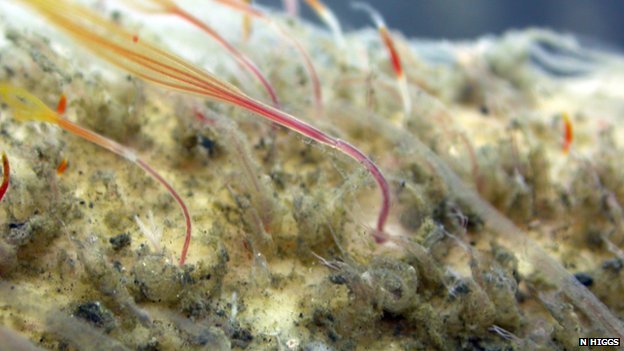
Zombie worm (Genus Osedax)  image from N Higgs via SOEST site

They found that there was not just one species of these worms, but several. And, as time went by, more and more were found around the world, with more and more variety. Worms are truly amazing creatures.

How does this relate to us here in Hawaii?  Well, one of the researchers at SOEST, our parent department, recently published a paper on zombie worm tracks in a 3 million year old Pliocene whale bone . It was from the Mediterranean (UH researchers get around), showing that these worms have been widespread in the oceans for a long long time.

So next time you take a swim, think about worms. Maybe the beautiful feather duster worms, maybe the fireworms you should not touch, or maybe the zombie worms that can take care of your bones once you are dead.

To really learn about zombie worms I suggest:
Monterey Bay Research Institute page on Zombie worms (beautiful pictures too): A Motley Collection of Bone Worms
SOEST News Release: Whale bone fossil records feast for “zombie worms”
BBC News Article: Fossil Feast for "Zombie Worms"


Bonus science nerd questions
1. Should the earthworms in movie zombies be considered parasites or scavengers - after all the zombies are dead, yet sort of living?
2. If you sink dead whales to work on zombie worms in the ocean, can you tell people at parties that you work with whales and dolphins and leave it at that? Or should you be more specific and tell them that you work on bone eating worms from the icy black depths of the abyss...
3. Will they invite you back?
4. Do you care knowing that you have given them a serious case of the heebie jeebies?

Aloha,

Mark

Friday, November 4, 2011

Friday Update 11-4-11

Aloha,

It has been a good week. We had four groups out this week; two community groups led by Don I. and Vivian, a large class from UH West Oahu and a home school group that participated in our plankton and invertebrate labs.  Thanks also to Mike C., Don B., Deena and Chris for leading these tours.
Next week is a bit slow, so we are offering, conditions permitting, a snorkeling and turtle search small boat tour on Wednesday, Nov. 9 for 6 of our active volunteers.  Please email us at himbcep@hawaii.edu by Monday AM.  We will take the first 6 who sign up.
Please take a look at the CALENDAR for tours that you may be able to lead.
And don't forget to see the blog entry, Our corals have Bad Gas
Have a great weekend.   Sal

Thursday, November 3, 2011

Bad Gas (Gas Bubble Disease)

Our mushroom corals have been suffering lately. Not mentally (no brains and all), but they have an issue. They have gas - bubbles (note the bloated tentacles).

Now as a diver I avoid getting bubbles. Gas is not so bad, that is merely an issue for your dive buddies to comment on in the car. But bubbles are another matter.  Bubbles in your blood or brain, or even under your skin are considered a "bad" thing. So divers avoid surfacing too fast to keep from sudden pressure drops on our system, leading to supersaturation, leading us to foam up like a popped open soda.

So how did our corals get bubbles? That is the $1000 question. They have not been diving and they did not go to a Mexican restaurant (maybe).

It could just be a basic issue of super-saturation, too much gas in the water. If animals are bathed in it (as in an aquarium), it may form bubbles in their skin as it comes out of solution. Which can lead to tissue death. Which can lead to animal death.

One way this happens is through injection of air via a leak in the pump line on the suction side. This is pretty common in big aquariums and institutes.


Another possibility is that we have a micro-algae bloom in the bay that is cranking up the oxygen in the water to extremely high levels. Plants release oxygen as they photosynthesize. If you have a plant plankton bloom, they can release so much oxygen into the water that it becomes supersaturated. If your pumps pull this in, you have a problem.

As I walked around the island today, I tested the oxygen levels at several sites. The shark lagoon was running at about 75% oxygen saturation.  The lagoon flat nearby was at 78.5%. Off to one side of the lagoon was a haze in the water, a micro plankton bloom. I dropped the oxygen meter in the bloom. The numbers jumped up dramatically, finally leveling off at about 140% saturation. Now there is some extra gas! Thankfully it was just a small patch and not the inlet water. Water on the sandy beach side was at about 112.2% saturation, which is actually still within normal parameters.

Generally speaking, super-saturation issues can be taken care of simply by creating a fountain somewhere in-line. As the water foams in the air, it also de-gasses back to a normal level. Our touch pool has a fountain-like area underneath to deal with this. And the water this morning was at 104% oxygen saturation, still within normal range.


So what is going on? The only thing I really noted was that if I turned down the inlet water, the corals got better. It is something in the water coming in from the bay. If not micro-algae making too much oxygen then???

Maybe we have water that looks clear, but is  nutrified (food particles and dissolved organics) and has a load of bacteria chowing down on it and breathing (back to the Mexican restaurant). You wouldn’t be able to see it, but all of those bacteria breathing would be releasing CO2 and continue to do so in the tank. You would get tissue bubbles regardless of the fountain below.

More tests are needed. This seems to happen every year, so we will keep working on the mystery! Meantime, we will turn down the inlet water on the tank that has the coral shown at the top of the page. Time to reduce its bubbles.

Aloha,

Mark